Farm and agricultural restroom rental in Round Rock runs a standard unit at 100 to 350 dollars a day or 125 to 325 dollars a month, with pricing driven by field distance and how many hand-labor crews need coverage. Ag operations often need units spread across acreage, not clustered in one spot.
OSHA 1928.110 sets the field sanitation baseline for agriculture: one toilet facility per 20 hand-labor employees, reachable within a quarter mile walk from where people are working. That is a different rule than OSHA portable toilet requirements written for construction sites, which fall under 1926.51(c) and count workers per 20, 40, or 50 depending on crew size. Farms in Round Rock spread crews across fields, orchards, or pasture, so the quarter-mile rule matters more than raw headcount. A 40-person harvest crew split across two fields a half mile apart usually needs two units, not one, because neither field is within walking distance of a single toilet. Potable water also has to reach the crew under OSHA 1926.51(a)(1), which is worth planning alongside restroom placement rather than as an afterthought. We help farm operators figure out unit count and placement together, the same way we do for construction site services and for smaller jobs covered on the how many porta potties do I need guide. A standard porta potty rental covers most row-crop and livestock operations. Larger operations running multiple crews at once sometimes do better with a monthly porta potty rental arrangement, since seasonal labor tends to run in multi-week stretches rather than single days.
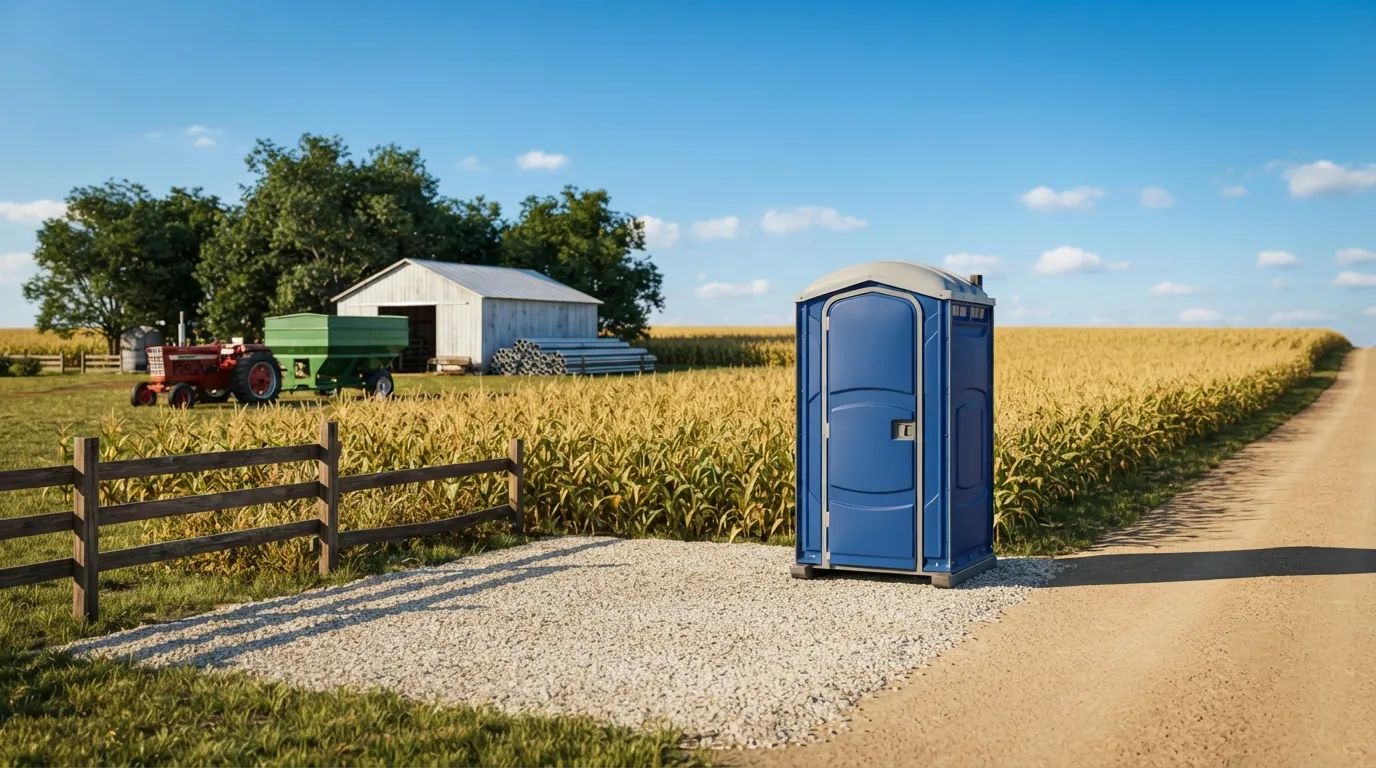
Placement on farmland is less about paperwork and more about ground and access. A unit weighs more once its tank fills, and the tank on a standard unit holds 60 to 70 gallons, so soft or sloped ground can tip a full unit if it is not seated on a stable pad. Our porta potty placement guide covers this in more depth, but the short version for ag sites: pick flat, compacted ground near the field edge, within that quarter-mile walk OSHA 1928.110 specifies, and clear of irrigation lines or vehicle paths. Round Rock's mix of clay and rocky soil means access roads matter more than distance. If a delivery truck cannot get within a reasonable pull-up distance of the pad site, service gets harder every week, not just on delivery day. For dumpster placement alongside restrooms during a barn build or equipment shed project, the same access logic applies, and our roll-off dumpster rental page covers clearance needs, including the roughly 60 feet of straight clearance a roll-off truck needs behind the container. Farms doing renovation work on outbuildings sometimes combine a restroom order with a dumpster order in the same trip, which saves a delivery fee.
Yes, and the requirement depends on what the crew is handling. If workers are applying pesticides, herbicides, or other chemical treatments, OSHA 1926.51(f)(1) requires washing facilities for that specific work. General crew sanitation, separate from chemical handling, still falls under the field sanitation rule in 1928.110. A handwashing station rental placed next to the restroom unit satisfies both needs at once, and under 29 CFR 1910.141(d)(2), any washing facility has to include soap and a way to dry hands, not just sanitizer. Hand sanitizer alone does not meet that standard. We set up combined restroom and handwash stations for spray crews, harvest crews, and packing operations across Round Rock, and for larger seasonal operations a portable sink rental can serve a packing shed or loading area separately from the field units. Farms closer to Hutto, about 8.1 miles east of Round Rock, and Brushy Creek, 6.9 miles west, get the same delivery terms we run in town. If your operation needs septic support alongside restrooms, our septic pumping service and how often to pump a septic tank guide cover tank intervals for farmhouse and bunkhouse systems, which typically run 3 to 5 years depending on tank size and household count.
| unit | duration | typical price |
|---|---|---|
| standard | day | 150 |
| standard | week | 200 |
| standard | month | 200 |
A standard unit runs 125 to 325 dollars a month, depending on service frequency and how far the unit sits from the road. Multi-unit orders across several fields usually price per unit, not as a flat package. See monthly porta potty rental for the full breakdown.
Yes. A single standard porta potty rental covers most small operations, and OSHA 1928.110 only requires one facility per 20 hand-labor workers, so a two or three person operation is well under that threshold either way.
ANSI/PSAI Z4.3 sets a baseline of one service visit per week for up to 10 users over a 40 hour week. Larger crews or longer hours need more frequent service, which we schedule around your harvest timeline.
Placement on private farmland is usually straightforward, but anything near a public road or right of way needs confirming with the city. Check our porta potty permit requirements page before finalizing a road-adjacent site.
Split coverage across fields rather than centralizing one unit, since OSHA 1928.110 requires a facility within a quarter mile walk. We help plan multi-field layouts as part of every request a quote call for Round Rock farm accounts.
Yes. Round Rock Porta Pros delivers farm and agricultural restrooms across Round Rock and the surrounding metro, with same-day and next-day drop-off available on most orders.
Pricing depends on the unit and how long you need it. See our cost breakdown and request a free quote for an exact figure.
Standard rentals include scheduled service — a pump-out, a clean, a restock and fresh deodorizer. Busy or hot-weather sites can be serviced more often.
Call now or request a free quote — clean units, on-time delivery, transparent pricing.